
Leadership at scale does not fail when complexity increases. Instead, it evolves into something fundamentally different as leaders move into roles with 30 or more direct reports. The nature of leadership shifts in quiet yet powerful ways, where the work may look familiar on the surface while the mechanics underneath operate on a completely new level.
At this stage, impact no longer comes from effort alone or from staying close to every decision. Effectiveness emerges from understanding how influence expands and how small actions travel across a much larger system over time.
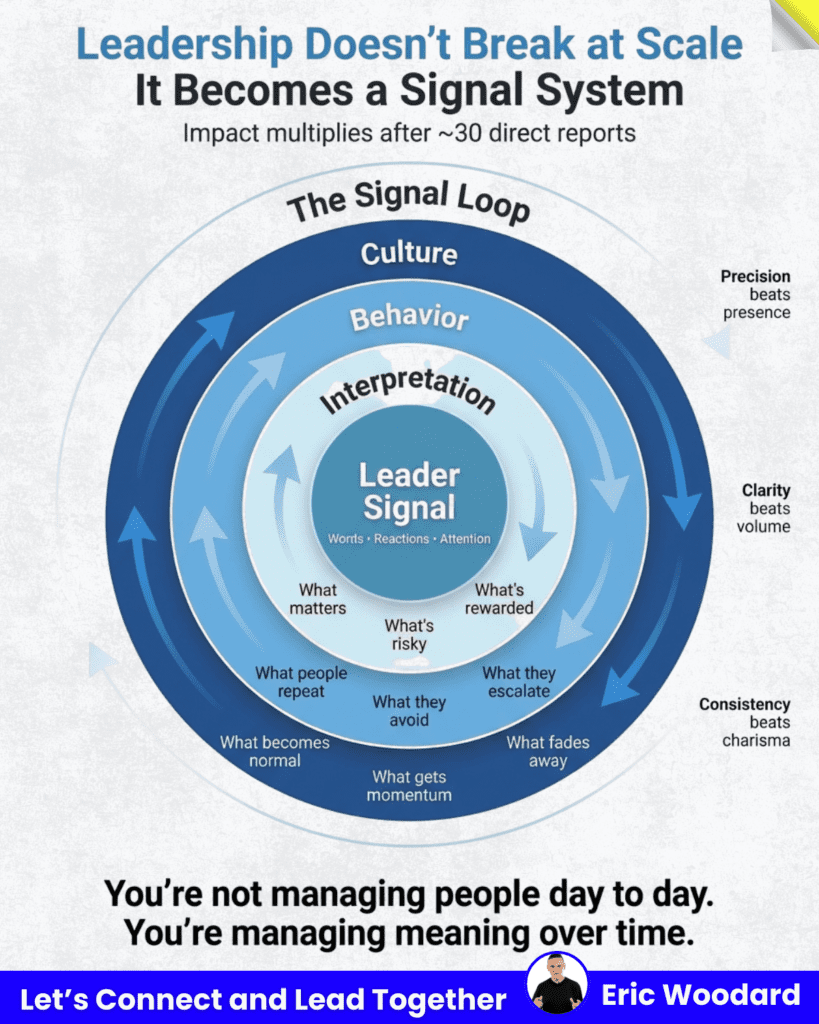
Leadership at Scale Becomes a Signal Problem
In smaller teams, leadership often centers on motivation and momentum. Leaders stay close, encourage frequently, and adjust in real time. That approach works early on. Leadership at scale, however, operates on signals rather than motivation. Each statement, reaction, and decision sends information far beyond its original audience.
Because signals multiply quickly, leadership at scale demands more intention. A single message can shape conversations across multiple layers of the organization. Over time, teams respond less to direct instruction and more to patterns they observe consistently.
Small Team Habits Create Friction
Many leaders encounter tension during this transition. The habits that once fueled success begin to lose effectiveness as teams grow. More communication feels productive at first, yet it often turns into background noise. Increased visibility starts to distract rather than align.
Leadership at scale exposes these limits clearly. Consensus driven decision making slows momentum. Constant updates dilute meaning. As a result, leaders feel busy while teams struggle to identify what truly matters.
Leadership at Scale Rewards Precision Over Presence
Leadership at scale places a premium on precision. One well timed message can outperform repeated explanations. One clearly defined priority can guide teams for months. Presence still matters, yet its value comes from focus rather than frequency.
Precision creates trust. When leaders speak less and mean more, teams listen closely. Over time, leadership at scale becomes less about being everywhere and more about shaping direction through carefully chosen signals.

Leadership at Scale Means Managing Meaning Over Time
At higher levels, leadership at scale shifts away from daily oversight and toward long term influence. Leaders move beyond managing tasks and focus on managing meaning across the organization. Every team operates on shared stories, assumptions, and priorities, which leaders shape through repetition and reinforcement over time.
What leaders name consistently becomes reality for the team, and what receives attention gains importance. Meanwhile, what remains unspoken slowly loses relevance, as leadership unfolds through consistency and patterns rather than single moments.
Leadership at Scale Amplifies Clarity and Confusion
Leadership at scale magnifies everything as organizations grow. Clear direction spreads alignment across departments, while vague signals spread uncertainty just as quickly. As a result, even small inconsistencies carry real weight across teams.
Silence also communicates meaning, and delayed decisions send clear messages. Shifting priorities create ripples that move faster than expected, which requires awareness of this amplification effect and respect for how quickly signals travel.
Leadership at Scale Focuses on Direction Instead of Control
Control often feels reassuring, especially as complexity increases. Leadership at scale functions better through direction, since teams already possess energy, talent, and momentum. Effective leaders guide that energy rather than trying to contain it.
Clear direction invites ownership, while reduced noise increases focus. Over time, teams learn to move independently and stay aligned with shared goals, which allows leadership to feel lighter rather than heavier.
Leadership at Scale Is Built Intentionally
Strong leadership at scale rarely happens by accident. Leaders design their influence carefully. Signals are chosen with purpose. Messages are reinforced through action rather than constant explanation.
As patterns stabilize, teams begin to self correct and self organize. Leadership becomes sustainable. The organization gains rhythm, and the leader regains capacity to think long term.
Leadership at Scale Is a Different Kind of Mastery
Most leadership advice targets early growth and small teams, while Leadership at scale requires a broader lens. It values restraint, consistency, and clarity over intensity and constant motion.
Ultimately, effective leadership is not about adding more energy to the system. It is about directing the energy that already exists with intention, precision, and trust.

Final Thought
Leadership at scale is not a louder version of leadership. It is a quieter, sharper, and more deliberate practice that emerges as teams grow and influence compounds. Clarity becomes the leader’s most valuable asset, especially as signals travel farther and patterns matter more. The leaders who thrive understand that their real work is not constant motion. Instead, it is shaping meaning, reinforcing priorities, and directing energy with intention. When this approach is designed thoughtfully, organizations move faster with less friction and leaders regain space to think, decide, and lead with purpose.
Frequently Asked Questions
What does leadership at scale mean? It refers to leading large teams where influence spreads through signals rather than daily interaction. At this level, clarity and consistency shape outcomes more than constant involvement.
How does leadership at scale differ from leading small teams? Leading small teams relies on presence and frequent feedback, while larger environments require direction and long term meaning. Influence travels farther and patterns matter more than individual moments.
What skills matter most in leadership at scale? The most important skills include clarity, restraint, and intentional communication. Strong prioritization and consistency over time also play a major role.
What common mistakes appear in leadership at scale? Many leaders rely on small team habits such as over communication and consensus building, which creates noise in larger systems. These patterns often slow alignment and reduce focus.
How can leaders improve their effectiveness at leadership at scale? Effectiveness improves by simplifying signals and reinforcing a few clear priorities. Over time, consistent action builds alignment without constant intervention.