

Senior leaders do not lose their edge as they climb. Leadership Communication plays a key role in helping them continue to inspire and guide their teams effectively.
Instead, they lose their leverage.
The reason is simple. They never evolved their leadership communication.
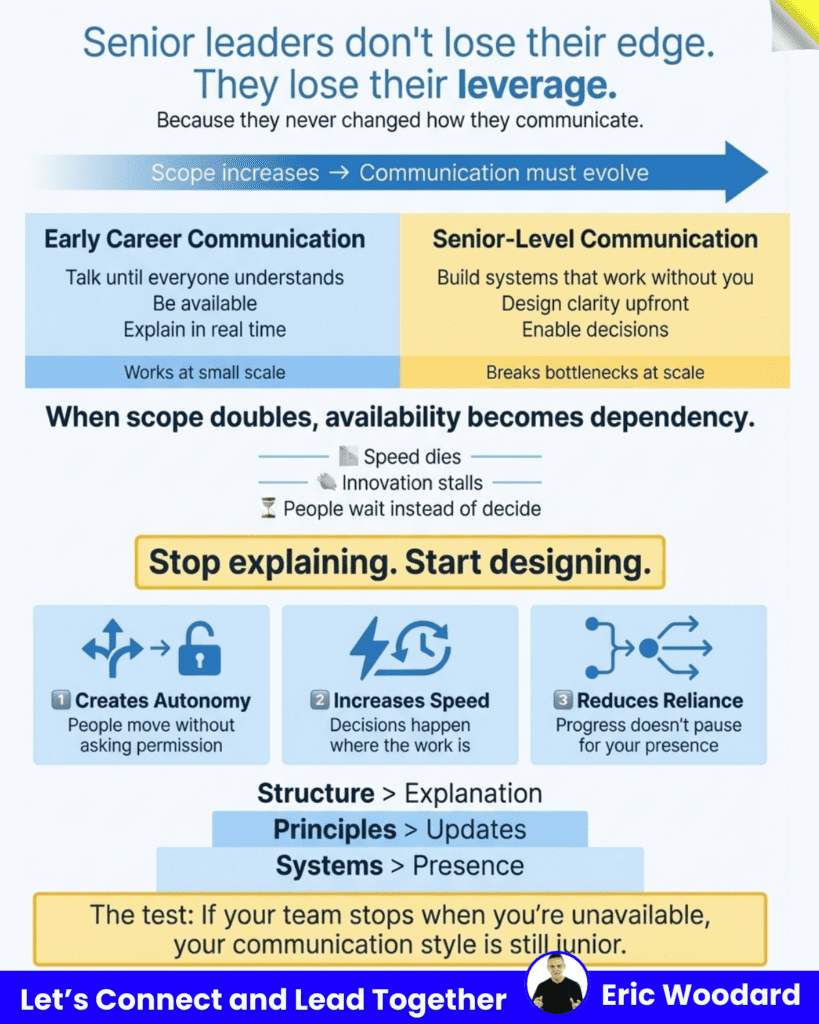
Early in your career, communication is about clarity. You talk until everyone understands. Then the ideas get repeated to reinforce clarity. Every question receives an immediate answer.
However, as your scope expands, that approach breaks.
At higher levels, leadership communication must scale beyond your presence.
Otherwise, availability becomes dependency. And dependency quietly limits performance.
Speed slows down. Innovation hesitates. People wait instead of deciding.
Therefore, the shift is not about talking more. It is about designing better.

Why Leadership Communication Must Evolve as You Scale
At the beginning of your career, explaining works. In fact, it builds credibility. Yet as responsibility grows, explanation alone cannot keep up.
When your scope doubles, your time does not.
As a result, executive communication must move from conversation to structure. Instead of reacting in meetings, you design principles that guide decisions without you.
Moreover, if your team pauses when you are unavailable, your leadership communication is still operating at a junior level.
Senior leaders understand something critical. Structure beats explanation. Principles beat updates. Systems beat presence.
Consequently, communication becomes less about volume and more about design.
The Three Outcomes of Strong Leadership Communication

Effective leadership communication at senior levels produces measurable impact. Specifically, it creates autonomy, increases speed, and reduces reliance.
First, autonomy expands. Your team moves without constantly asking for permission. Clear decision boundaries allow progress to continue.
Second, speed improves. Decisions happen where the work is happening. Instead of waiting for top down approval, momentum builds at every level.
Third, reliance decreases. Work does not pause because you are in another meeting. Progress continues even when you are offline.
In addition, executive communication that is principle driven builds trust. When expectations are clear, people act confidently.
Over time, this creates a culture where ownership replaces dependency.
Designing Leadership Communication That Scales
So how do you upgrade your leadership communication?
Start by asking yourself whether your words create clarity or reliance.
For example, are you answering the same questions repeatedly? If so, your leadership communication may be reactive rather than structural.
Instead of restating instructions, design frameworks. Rather than solving every issue, define guardrails.
Furthermore, communicate principles clearly and repeatedly. When people understand how decisions get made, they make better ones independently.
As your influence grows, executive communication becomes less about explaining tasks and more about shaping systems.
That is the real shift.
Senior leaders stop being the source of answers. They become the architects of environments.
And environments scale.
Frequently Asked Questions
1. What is leadership communication?
Leadership communication is the way leaders create clarity, direction, and alignment within their teams. At senior levels, it focuses more on systems and principles than constant explanation.
2. Why does communication style need to change at higher levels?
As responsibility increases, availability decreases. Therefore, leaders must design communication that enables autonomy rather than dependency.
3. How does leadership communication create autonomy?
Clear principles and decision frameworks allow team members to act confidently without constant approval. This increases both ownership and speed.
4. What is the biggest mistake senior leaders make?
Many continue explaining instead of designing systems. As a result, their teams rely on them too heavily.
5. How can I improve my leadership communication today?
Start by identifying repeated questions from your team. Then create clear principles or decision guidelines that eliminate the need for repeated clarification.
If your team stops when you stop talking, the structure is missing.
Upgrade the design.
Because leadership communication scales through systems, not volume.